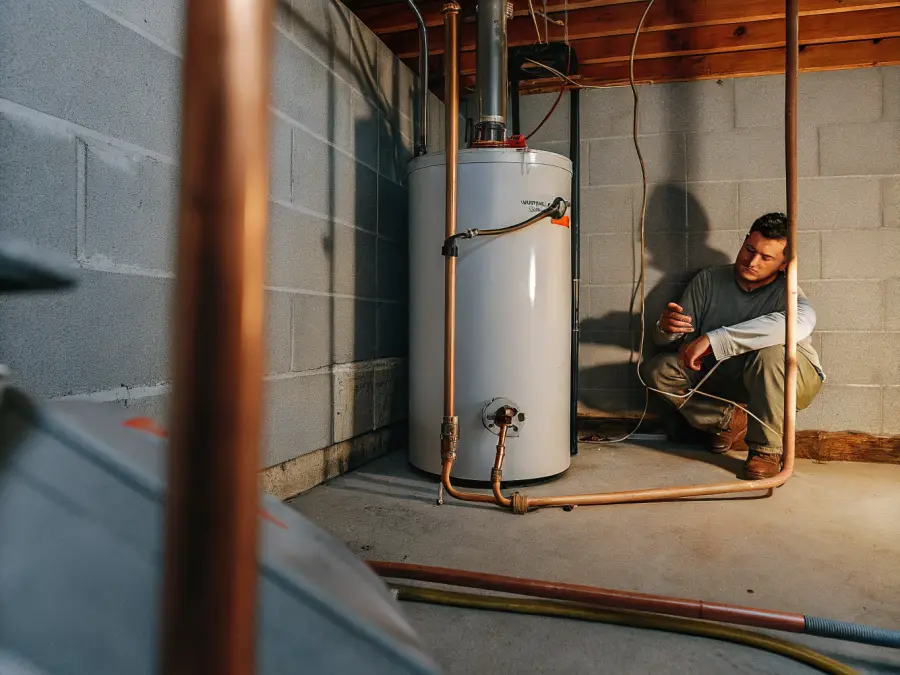
A leaking water heater usually comes from one of a few places: a loose or failing drain valve, a leaking temperature-and-pressure relief valve, sweating on the tank, loose pipe connections up top, or a tank that has rusted through from the inside. A valve or fitting is often a straightforward repair. A leak from the bottom of the tank itself almost always means it is time for a replacement.
First, do not panic, but do act. Water pooling around a heater can mean a five-dollar fix or a tank on its last legs, and the difference matters. The good news is you can usually narrow down the source yourself in a couple of minutes, which tells you how urgent it is.
Do this first to limit the damage
- Shut off the water to the heater at the cold-water valve on top, or at your main shutoff if you cannot find it.
- Kill the power. For an electric unit, switch off its breaker. For gas, turn the control to the pilot or off position.
- Mop up and watch where the water is actually coming from before you call, so you can describe it.
Common sources, from easiest to worst
The drain valve at the bottom
That little spigot near the floor can loosen or fail and drip. Sometimes it just needs tightening or a cap; sometimes it needs replacing. Either way it is a minor repair, not a new heater.
The temperature-and-pressure (T&P) relief valve
This safety valve on the side or top opens if pressure or temperature climbs too high. If it is dripping, it may be doing its job because of a real pressure problem, or it may simply be worn out. This one is worth having looked at, because it is a safety device.
Loose connections on top
The hot and cold pipes joining the heater can loosen over time and weep. Tightening or resealing a fitting is usually a quick fix.
The tank itself
If water is coming from the bottom of the tank and it is not a valve or a fitting, the tank has most likely corroded through from the inside. There is no patching a rusted tank. Once it is leaking through the steel, replacement is the only real answer, and it will only get worse.
Repair or replace?
If your heater is under about eight years old and the leak is a valve or a fitting, a repair usually makes sense. Past ten years, or with the tank itself leaking, replacement is almost always the better value than pouring money into an old unit that is going to fail anyway. An honest plumber will give you the math both ways rather than defaulting to the bigger sale.
When to call right away
A slow drip you have contained can wait for a scheduled visit. Water spreading fast, a tank leaking from the bottom, or any sign of scalding-hot water or a gas smell is a call-now situation. If you are not sure, shut the water off and call. We would rather talk you through it than have you mop all night.
Not sure what you are looking at down there? Shut off the water, snap a photo of where it is leaking, and give us a call. We will tell you honestly whether it is a quick repair or a replacement.